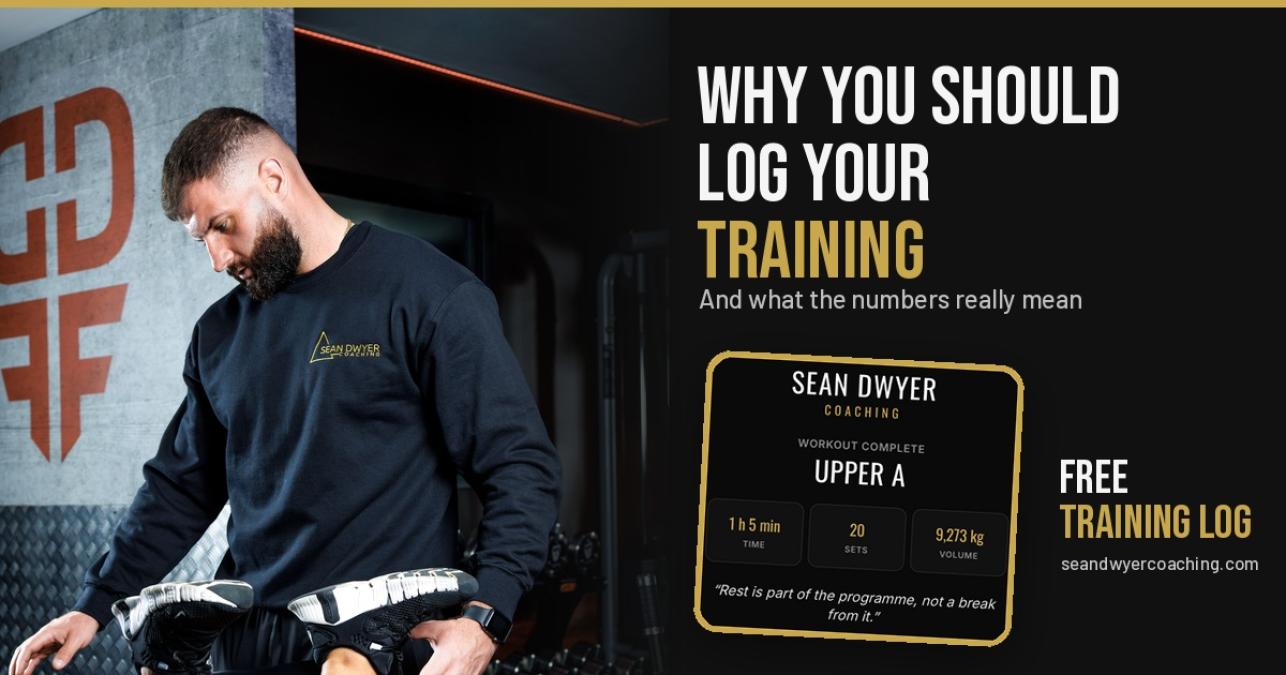
Why You Should Log Your Training (And What the Numbers Really Mean)
Let me ask you something. What did you squat six weeks ago?
Most people have no idea. They train hard, they turn up, they leave the gym feeling like they did something, but they've no way of knowing if it's actually working. That's a big reason people stall.
I get asked about this all the time with clients, so here's how I look at it: why you should log, why you don't need to beat the book every session (this one trips a lot of people up), how to tell if you're really progressing, what it means when your weights go up or down, and how a log keeps you accountable.
Why you should log your training
Your memory isn't as good as you think. You'll remember the PRs and the awful sessions. You forget everything in between, and that's where most of your progress is made.
Progress is just doing a wee bit more over time. A bit more weight, a few more reps, an extra set, or the same work done better. But you can't do more than last time if you don't know what last time was.
Writing it down gives you:
- Something to aim for before you even pick up the bar
- A record of the trend, not just how today felt
- Proof it's working, or proof it isn't
- Facts to make decisions with, not feelings
You don't need to write a novel. Weight, sets, reps and how hard it felt. If you want to add a quick note on sleep or mood, even better. It takes seconds.
You don't need to beat the book every session
This is where a lot of people go wrong. They see the log and every session turns into a race. More weight, more reps, every time.
It doesn't work for long, and it can make your training worse.
The job of a session is to do the planned work well. Hit the reps, keep your technique tidy and train at the right effort. If the plan says 3 sets of 8 and you get them cleanly with a couple of reps left in the tank, that's a good session. Matching the book is still progress, because it shows you can repeat it.
When you chase the book at all costs:
- Your range of motion gets shorter, so the weight looks heavier on paper but you're doing less
- Reps get rushed and sloppy
- Every set goes to failure and you build fatigue quicker than you build muscle
- Injury risk goes up
A lift only counts if it's done the same way every time. Same depth, same tempo, same control. If you added weight by cutting corners, you haven't progressed, you've just changed the exercise. I see it all the time.
An easy way to progress without chasing numbers is double progression. Pick a rep range, say 8 to 12, and stay at the same weight until you hit 12 on every set with good form. Then go up a little and start back at 8. Clear target, no guessing.
How to tell you're making progress
Don't judge it off one session. One day can be thrown off by sleep, stress, food or a mad week at work. Look at the trend over 4 to 6 weeks.
In your log, progress looks like:
- More reps at the same weight
- Same weight and reps, but it feels easier
- More weight for the same reps, with the same technique
- Same numbers with better control, depth or tempo
- An extra set without the quality dropping
You can make progress without the number on the bar changing. If the same weight feels lighter, moves better and leaves more in the tank, you've improved.
Look outside the log as well. Measurements, photos and how your clothes fit tell you what the training is doing for your body. The log tells you what you can do, and those tell you what it's doing for you.
What it means when your weights go up, and when they go down
When the weight goes up
Usually it's good news. Your strength, your technique, or both, are improving. Just check the reps and the quality. If the weight went up but your depth got shorter or the reps got messy, it's not a real increase.
And if the weight goes up every single week, ask yourself if you're progressing or just testing yourself every session.
When the weight goes down
Don't panic. A dip doesn't mean you're failing, it's information. Work out why. Start with the training, then look at life.
Check the training first
- Recovery: your weights drop across a few sessions in a row. Check the days between sessions and how sore or flat you feel.
- Too much volume: you're strong at the start of the session and fall off by the end. Check how many hard sets you're doing per muscle each week.
- Exercise selection: one lift stalls or drops while the others improve. Check whether it suits your body and skill level, or if you changed the exercise recently.
- Frequency: weights drop after a gap, or you're hitting the same lift too often. Check how often you train it each week.
- Effort: weights fall because every set goes to failure. Check how many reps you're leaving in the tank.
Then check your life
- Stress: work, family and money all come out of the same recovery pot as your training
- Sleep: a few short nights and your lifts will show it
- Food: not eating enough, or not enough protein, makes it harder to recover and perform
- Food timing: training fasted or without a proper meal beforehand can leave you flat
- Hydration: even a bit dehydrated can make everything feel heavier
- Illness or travel: coming back from either, expect a dip
Change one thing at a time. If you change your programme, your food and your sleep all at once, you'll never know which one fixed it.
What your data teaches you
After a few months your log stops being a record and starts being a coach. It shows you things you can't see from inside one session.
- What works for you. Some people grow on 3 sets, others need 5. Your log shows you which one you are.
- What came before a stall. You might notice every dip follows a week of bad sleep or a stressful spell at work.
- When you need a lighter week. If your numbers drop for 2 or 3 sessions in a row, that's a sign to back off, not push harder.
- Which exercises suit you. A lift that keeps going up is doing its job. One that never moves might need swapping.
- How you respond to food and recovery. Compare your best weeks to your worst and the pattern is usually obvious.
It's also what I look at when I adjust a client's programme. Good data means better decisions.
It keeps you accountable
Results come from consistency, and a log makes it easy to see.
When you write down every session, a missed week shows up. So does a run of 12 weeks without missing one. On the days you can't be bothered, that run is a decent reason to turn up. Nobody wants to break it.
It keeps you honest too. If you did 8 reps and not 10, it's there in black and white. You can't tell yourself you trained hard when the numbers say otherwise, and you can't say you're not progressing when they say you are.
Adherence beats perfection. You don't need the perfect programme or a PR every week. You need to turn up, do the work properly and write it down. Do that for months and the results come.
Start logging with my free Training Log
I built a free Training Log so you don't need a notebook or a spreadsheet. You save it to your phone's home screen like an app, there's no account to set up and your data stays on your phone. There's a Push, Pull, Legs plan built in as well if you need somewhere to start.
Get the free Training Log here: log.seandwyercoaching.com
If you'd rather have a plan built around your life, and someone to go through your numbers with you and change things when they dip, that's what my online coaching is for. Have a look at the coaching page.
Pick your next session, write down the weights, and don't worry about beating anyone but yourself. In 6 weeks you'll know exactly where you stand.

Sean Dwyer
Belfast-based personal trainer and online coach with a BSc (Hons) in Sport, Fitness & Coaching and over 12 years of experience coaching clients in person and online.
More about SeanYOU MIGHT ALSO LIKE

No Time to Train? How to Get Results in 3 Sessions a Week
Five sessions a week was never realistic. Here is how busy parents and professionals get real results from three, and what to do on each day.
4 November 2026
Read More
Is Your Child Falling Behind? The Truth About Youth Strength and Conditioning
Is strength training safe for kids? What is long-term athletic development? A plain guide for parents and coaches, backed by the research.
7 October 2026
Read MoreGET EXPERT COACHING
Want personalised guidance to reach your goals faster? Work with a BSc-qualified coach with over 12 years of experience.
Learn About Coaching