Banking Calories: Stay on Plan and Still Enjoy Your Weekend
By Sean Dwyer, BSc (Hons) Sport, Fitness & Coaching··8 min read
You shouldn't have to choose between your plan and your life
Monday to Friday, you nail it. Food on point, training done. Then Saturday arrives. A birthday party, a family dinner, a few drinks with friends, and by Sunday night you're thinking "what's the point?"
So the next week starts with guilt, a stricter diet and a promise to be "good". Two weeks later the whole thing falls apart.
I see it all the time, and I live it too. I'm a dad with a son who plays four sports, so weekends are full of matches, family and food. I'll have the odd couple of pints of Guinness here and there, and me and my wee man love a movie night with sweets and popcorn. I'm not giving those up, and you shouldn't have to either. If your plan can't survive that, it was never a good plan.
The fix isn't more willpower. It's planning ahead, and one of the simplest ways to do that is banking calories.
What is banking calories?
Banking calories means you plan your calories across the week instead of treating every day as a separate pass or fail. You eat slightly less on a few days, "bank" those calories, and spend them on the day you know you'll want more, such as a family meal, a night out or a barbecue.
Your weekly total stays the same. You just move the calories to where you'll actually enjoy them.
Why it works
Your body doesn't reset at midnight. What matters for fat loss is your calorie intake over time, not whether one day lands exactly on target. A planned higher day inside a weekly budget doesn't undo your progress.
It's easier to stick to. A rigid "never off plan" approach is hard to keep up. Research backs this up. A study by Westenhöfer and colleagues found that flexible control of eating was linked with lower body weight, fewer and milder binges, and a higher chance of weight loss success over a year, while rigid control was linked with more disinhibited eating and more severe binges.
It stops the "ruined it" spiral. If one big meal can't ruin your week, there's no reason to write the rest of it off.
One honest warning. Banking only works when it's planned and kept moderate. A 2018 study of more than 7,000 app users found that people whose calorie intake stayed fairly steady across the week lost more weight than those with big swings. So think of banking as a small, deliberate shift, not a licence to starve Monday to Friday and go wild at the weekend.
How to bank calories, step by step
Know your daily calories. Use the free calorie calculator to get your daily target and protein.
Work out your weekly budget. Multiply your daily calories by 7. That's your weekly total, and the number you protect.
Look at the week ahead. Spot the day that's going to be tough to stick to the plan, like a birthday, a match day with food after, or a night out.
Bank a little. Take 100 to 200 calories off each of the days before it. Small amounts add up, and you'll barely notice them.
Spend it on the day. Enjoy the meal or the drinks without guilt, and keep your protein in as normal.
Go straight back to normal. No punishing the next day, no skipping meals, no extra cardio to "make up for it".
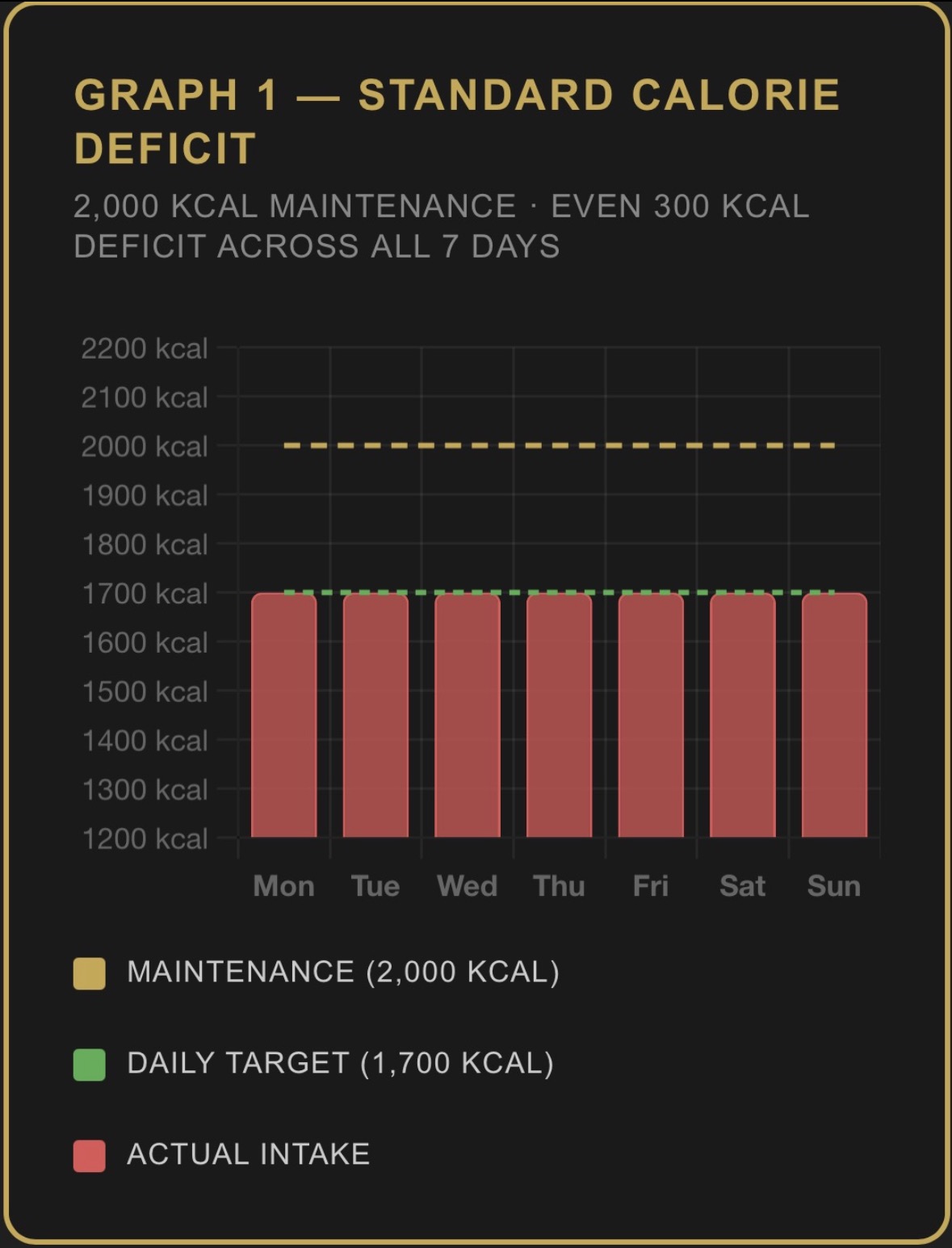
Here is what that looks like in a real week. I'll use someone with a maintenance of 2,000 calories who is aiming for a 300 calorie deficit. These are example numbers, not yours.
This is how most people diet. Maintenance is 2,000 calories (the gold dashed line). The daily target is 1,700 (the green line), and every single day, Monday to Sunday, the actual intake is 1,700. That is a 300 calorie deficit a day, so around 2,100 calories a week below maintenance.
The maths works. The problem is real life. Saturday is a family barbecue or a night out, and on a plan like this there is no room for it. So you either stay rigid and miss out, or you blow the day and start thinking the week is gone.
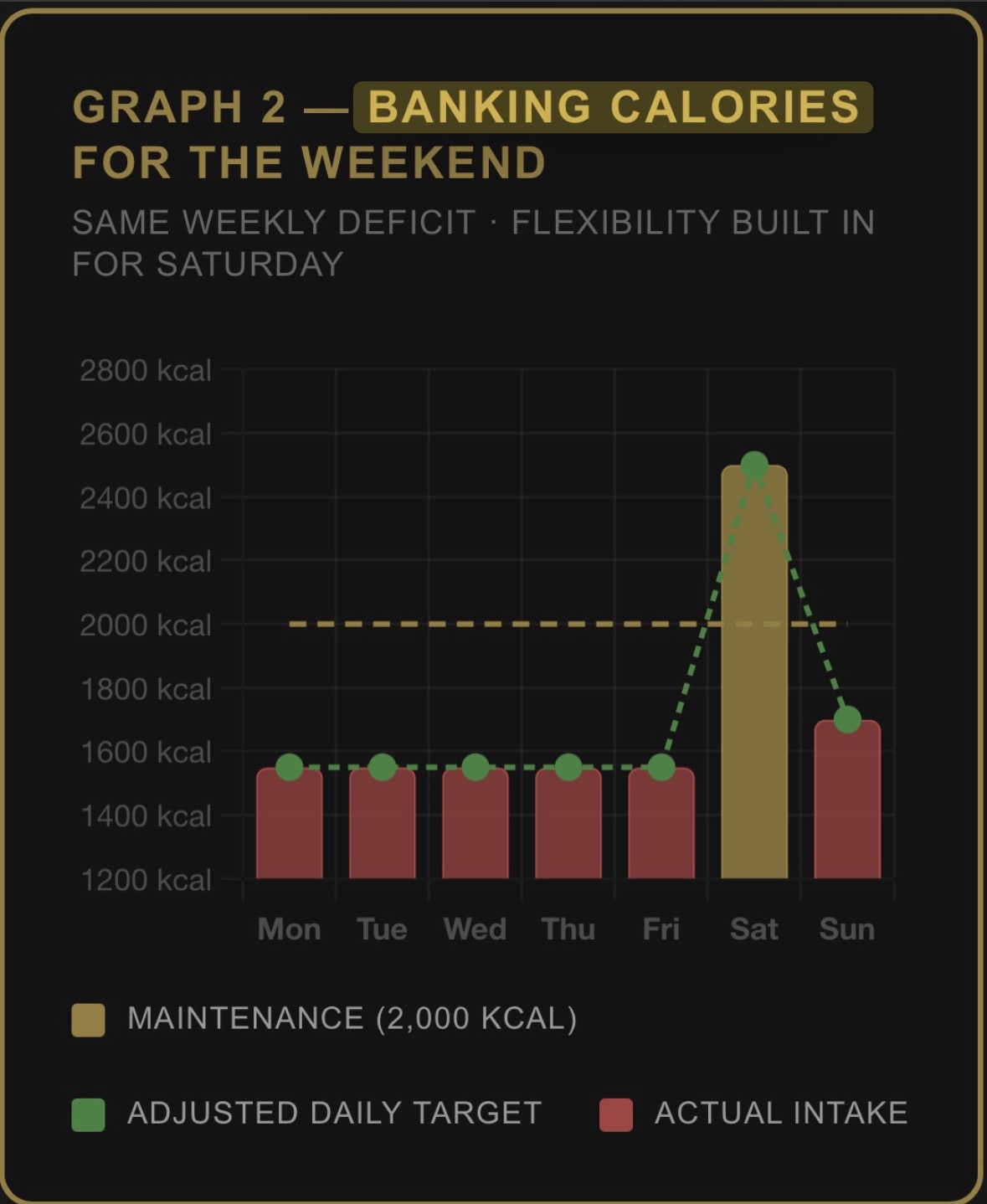
Same person, same maintenance, same goal. The difference is that the calories are planned across the week instead of split evenly. Monday to Friday, the daily target drops to about 1,550. That's only 150 calories under the 1,700 from Graph 1, and most people barely notice it. Over five days you bank around 750 calories.
Saturday, you spend it. The target goes up to 2,500, so you can enjoy the meal, the drinks and the day without watching every bite. Sunday you are back to roughly 1,700 and the week carries on as normal.
Add it up and the weekly total is about 11,900 calories in both graphs, well within a rounding error of each other. The weekly deficit hasn't changed. You've simply moved calories from days you'd barely feel them to the day you'll enjoy them most.
What to take from the two graphs
Graph 1 asks you to be perfect every day. Graph 2 asks you to plan ahead. One breaks the first time life gets in the way, and the other is built for it. Notice too that the Saturday spike is planned and the week around it is controlled, which is exactly why banking works and why it isn't just "eating what you like at the weekend".
Using it for family time and social events
Family meals and parties. Birthday parties, Sunday dinners and barbecues are part of life. Decide in advance which meal is the big one, bank for it during the week, and then eat it properly. Enjoying a meal with your family is the whole point of having a plan you can live with.
Match days and kids' sport. If the weekend is a run of matches, lifts and snacks in the car, bank earlier in the week so you aren't trying to be perfect on the sideline.
Nights out. Drinks add up faster than most people expect, so plan the night rather than winging it. Bank for it, eat a proper meal with protein earlier in the day, and stop worrying. My free Alcohol Guide on the site covers how to plan a night out without losing your progress.
Holidays and weddings. Treat the day itself as the event. Bank a little in the days before, enjoy it, and go back to normal the next morning.
Five rules so banking doesn't backfire
Keep it small. Bank 100 to 200 calories a day over a few days, not a huge amount over the whole week.
Plan the event, not the whole weekend. One meal or one night is the target, not Friday to Sunday.
Don't starve to bank. If you're ravenous by Thursday, you've banked too much.
Hit your protein every day. It keeps you fuller and protects your muscle, including on the big day.
Reset the next day. One higher day inside your weekly budget changes nothing. Compensating for it with a crash diet does.
One caution. If you have a history of disordered eating, speak to a professional before planning your calories this way.
Where to start
Start by getting your numbers. The free calorie calculator takes about 10 seconds and gives you your calories, your protein target and a sample day of eating. Then grab my free Fat Loss Guide for how to build a deficit you can actually sustain.
If you want the whole plan done for you, Project 90 3 Day gives you the training structure for a busy week. It's a one-off payment of £97, with no subscriptions and access for life.
If you'd rather have someone in your corner to plan weeks like this with you, apply for one-to-one coaching, in person in Belfast or online.
Frequently asked questions
How many calories should I bank?
Keep it small. I'd bank 100 to 200 calories a day across a few days, rather than a big amount, so you never feel like you're starving.
Does banking calories work for fat loss?
It can, as long as your weekly total still puts you in a deficit and you plan it. The idea is to move calories around the week, not to eat more overall.
Can I bank calories for a night out?
Yes. Plan it ahead, bank across the days before, and eat a proper meal with protein earlier in the day. Drinks add up quickly, so it helps to decide your limit before you go.
What if I go over my plan on the day?
Draw a line under it and go back to normal the next day. One higher day doesn't undo your progress. Skipping meals to make up for it usually does more harm than the extra calories.
This article is general information, not medical advice. If you have a medical condition, speak to your GP before changing your diet.
Belfast-based personal trainer and online coach with a BSc (Hons) in Sport, Fitness & Coaching
and over 12 years of experience coaching clients in person and online.
Supplements won't fix a bad diet or inconsistent training, but the right ones genuinely help. Here's exactly what I take, why, and what I've actually noticed using them.